

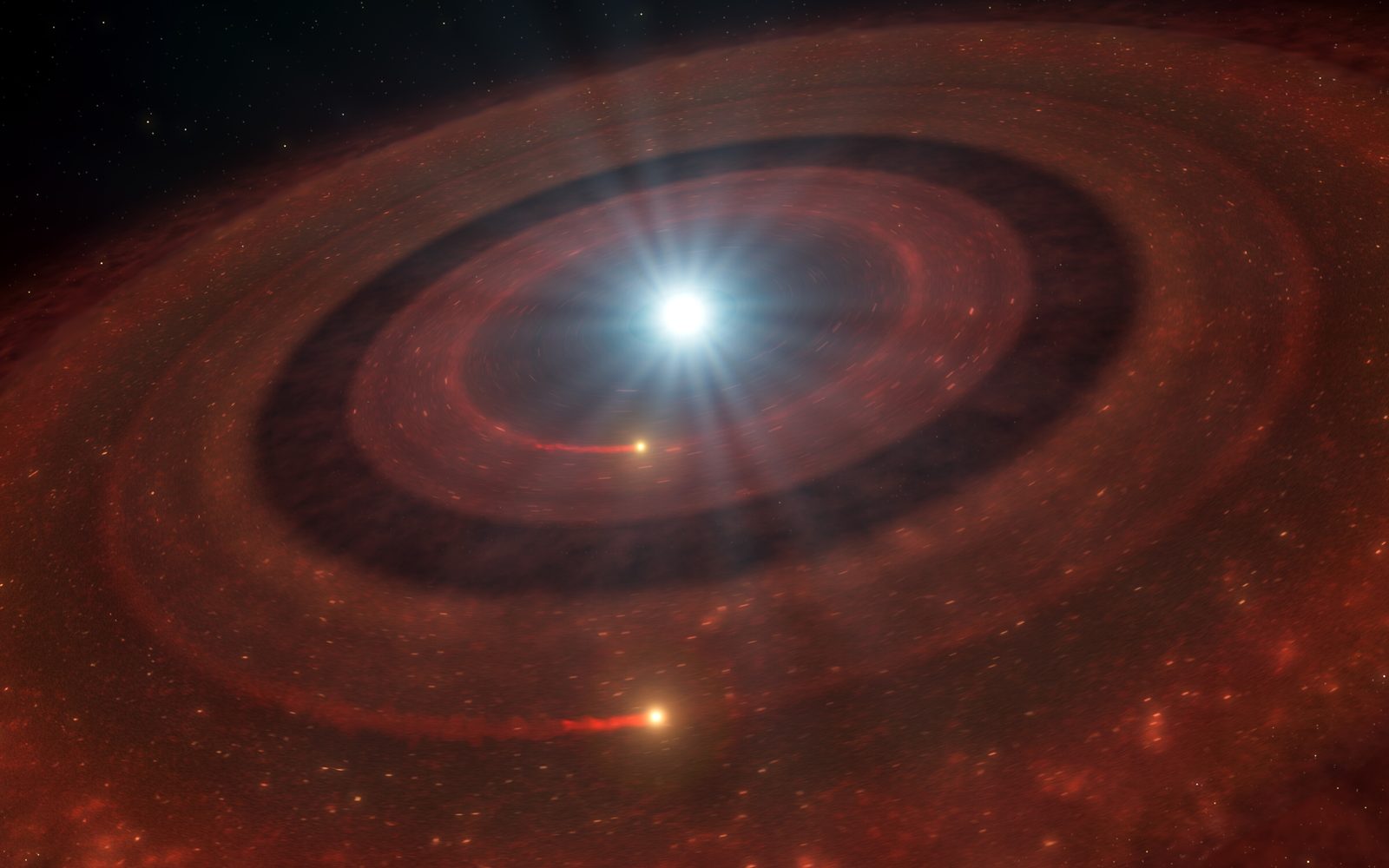
White dwarf WD J1328−1450 is a dead star about 1,600 light-years away, and it's doing something no other dead star we know of does. It's wearing two rings of glowing gas instead of one, with a clean gap between them.
That gap is the clue. Something is keeping it clear. Astronomers think the most likely culprits are two chunks of rock that survived the death of their star and are still circling the corpse. One may be as big as Pluto, or even our Moon.
And here's the part that should make you sit up: this is roughly what our own Solar System could look like, billions of years from now.
What is WD J1328−1450?
It's a white dwarf, the leftover core of a star a lot like the Sun. When a Sun-like star runs out of fuel, it swells into a red giant, sheds its outer layers, and leaves behind a hot, dense core about the size of Earth. No more fusion. It just slowly cools for billions of years.
Planets don't get a gentle ride through that process. The closest ones get swallowed. The ones farther out can survive, but their orbits get shaken up as the star loses mass. Every so often, something gets nudged inward, wanders too close to the white dwarf, and is torn apart by its gravity. The shredded rubble spreads into a flat disc around the star.
We've found plenty of those discs. What makes this one special is the shape.
What did astronomers find?
A team led by Nicola Gentile Fusillo of the University of Trieste in Italy, working with astronomers at the University of Warwick and other institutions, studied the star with the X-shooter instrument on ESO's Very Large Telescope in Chile. The results were published in Nature Astronomy and announced by ESO on October 27, 2026.
Nobody can photograph a disc this small from 1,600 light-years away. Instead, the team split the star's light into a spectrum. Gas swirling around a star leaves a telltale fingerprint: the side moving toward us is shifted a little bluer, the side moving away a little redder. A single ring of gas gives a signal with two peaks. All 21 similar gas discs known before this showed exactly that.
WD J1328−1450 showed four peaks. The simplest explanation is two separate rings, spinning at different speeds, at different distances from the star.
How big are the two rings?
According to the University of Warwick, the inner ring runs from about 62,000 to 149,000 miles (100,000 to 240,000 km) from the star. The outer ring starts around 233,000 miles (375,000 km) and stretches past 800,000 miles (1.3 million km).
To picture that: the Moon orbits Earth at about 239,000 miles (384,000 km). So the outer ring begins at roughly the Moon's distance and reaches more than three times farther. The entire double disc would fit inside a space only about twice the width of our Sun. Tiny, by cosmic standards, and wrapped around a star no bigger than Earth.
The gap didn't flicker in and out, either. Co-author Felipe Lagos-Vilches of Warwick said the rings are "remarkably stable and remain separated by a gap" across more than two years of observations.
What is carving the gap?
This is where we move from what was measured to what was inferred, so let's be clear about which is which.
Confirmed: two rings of gas, a gap between them, and a different recipe in each. The gas contains calcium, oxygen, magnesium and iron, which are the ingredients of rocky planets like Earth. The inner ring is rich in magnesium. The outer ring has far less.
Inferred: the team's models suggest each ring is fed by its own solid body orbiting inside it, grinding against dust and releasing gas as it goes. The inner body would be small, roughly asteroid-sized. The outer one could be as large as Pluto or even the Moon. Nobody has seen either body directly, and the team says so plainly.
The different chemistry fits that picture. Two different objects would have two different compositions. Another possibility the team raises is that both rings come from different layers of one shattered world, such as crust in one ring and core material in the other.
Warwick's Boris Gänsicke put the reaction simply: "a white dwarf with two separate discs is a real surprise."
Is this the same dead star with a planet in the habitable zone?
No, and it's an easy mix-up. Back in 2022, a team led by Jay Farihi of University College London reported a different white dwarf, WD1054–226, about 117 light-years away. That star dims on a regular schedule as dozens of clumps of debris pass in front of it, in an orbit that sits in the star's habitable zone.
WD J1328−1450 is a separate star, found with a separate method. Nobody is claiming anything habitable here. The headline is the strange two-ring structure and what it says about survivors.
Can you see WD J1328−1450?
Not with your eyes, binoculars or a backyard telescope. Stars like this are faint and Earth-sized, and this one is about 1,600 light-years away. Even the rings themselves will never show up as a picture. They were only revealed by splitting the star's light with one of the world's largest telescopes.
The image at the top of this page is an artist's impression, not a photo.
Why this matters
Run the clock forward about five billion years. The Sun swells into a red giant. Mercury and Venus are gone. Earth is very likely gone too. What's left is a white dwarf with whatever survived out in the colder, farther parts of the Solar System, and those survivors now have wobbly orbits around a shrunken star.
Some of them will eventually fall inward and get shredded. And if that happens to two different objects at once, an alien astronomer might see exactly what we're seeing at WD J1328−1450: two rings, two recipes, and a gap.
That's what makes this discovery hit differently. It isn't just a weird disc. It's evidence that planetary systems don't simply end when their star dies. Bits of them keep orbiting, colliding and shaping things long afterward. The Solar System's final chapter might not be a blank page. It might be rings.
What's next?
The team wants sharper and longer observations to pin down what's really inside each ring, and whether the two bodies are actually there. Gänsicke says he's eager to learn "which planetary bodies may have shaped this unusual system."
The four-peak fingerprint is also a new thing to look for. Now that astronomers know what a double disc looks like in a spectrum, they can go back through other white dwarfs and check whether any more are hiding a second ring.
So here's the question: if something from our Solar System outlives the Sun, which world do you think makes it? Jupiter, a Moon-sized icy body out past Neptune, or something we haven't even found yet?
Sources
- ESO: Dead star and planetary bodies: astronomers spot unique disc of debris that foretells Solar System's future (Oct. 27, 2026)
- University of Warwick: Astronomers spot unique double disc of debris that hints at Solar System's future
- Nature Astronomy: A double debris disc around a white dwarf sculpted by two planetary bodies (Gentile Fusillo et al.)
- Universe Today: Dead Planets Orbiting a Dead Star
- EarthSky: Is this our solar system's future? Scientists spot disk around dead star
Enjoyed this? Ancient Skies is free and made by one space fan. Buy me a coffee ☕
Keep reading
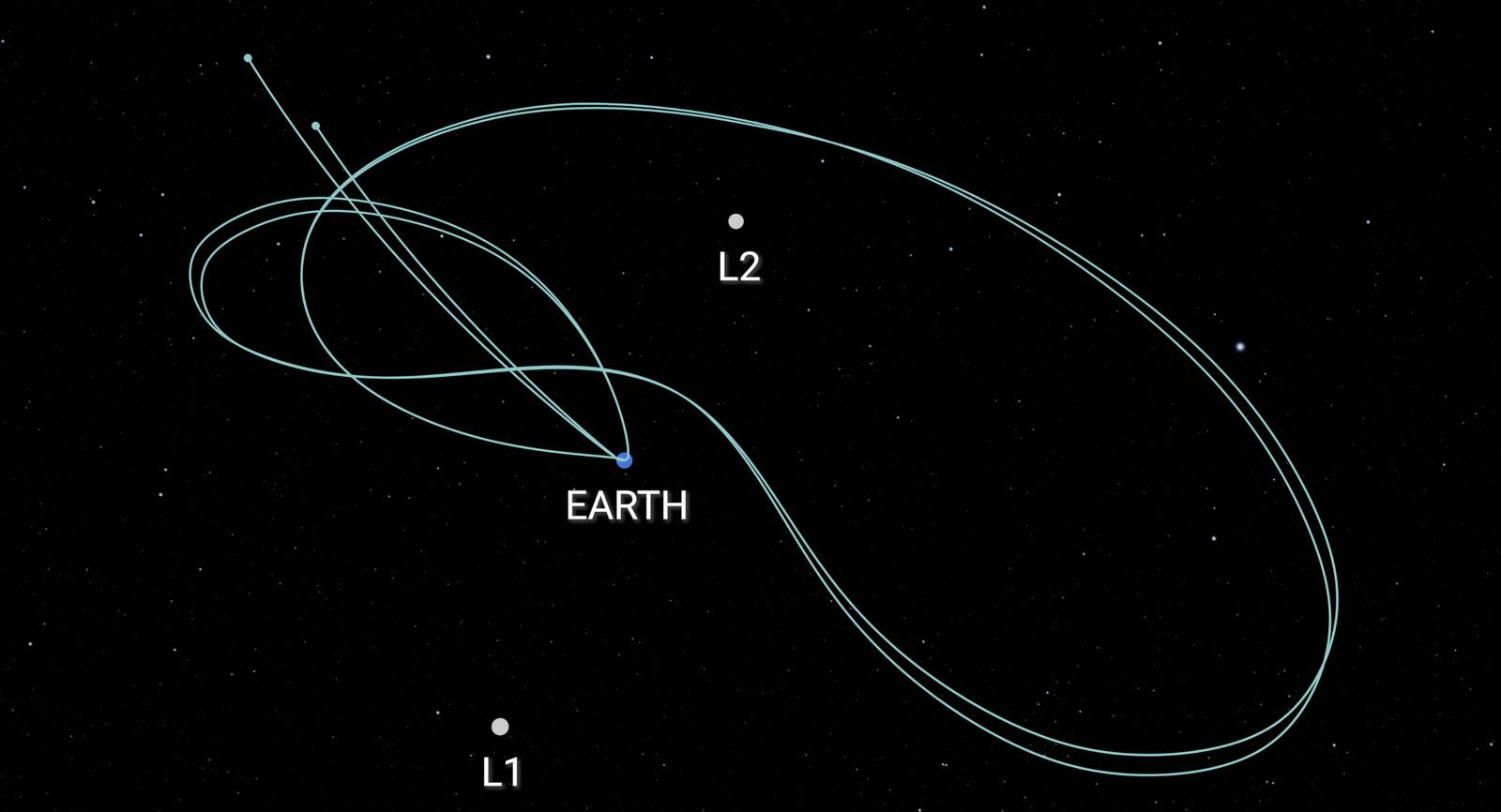
Why NASA's ESCAPADE Mars Twins Are Swinging Back Past Earth This Week
NASA's twin ESCAPADE probes return to Earth Nov. 7 and 9 for a slingshot engine burn that sends them to Mars. Here's how it works and how to spot them.
November 3, 2026 · 5 min read
Today in Space History, Nov. 3: Mariner 10 Heads for Mercury by Way of a Venus Slingshot
On Nov. 3, 1973, NASA launched Mariner 10, the first probe to visit Mercury and the first to use one planet's gravity to reach another.
November 3, 2026 · 3 min read