

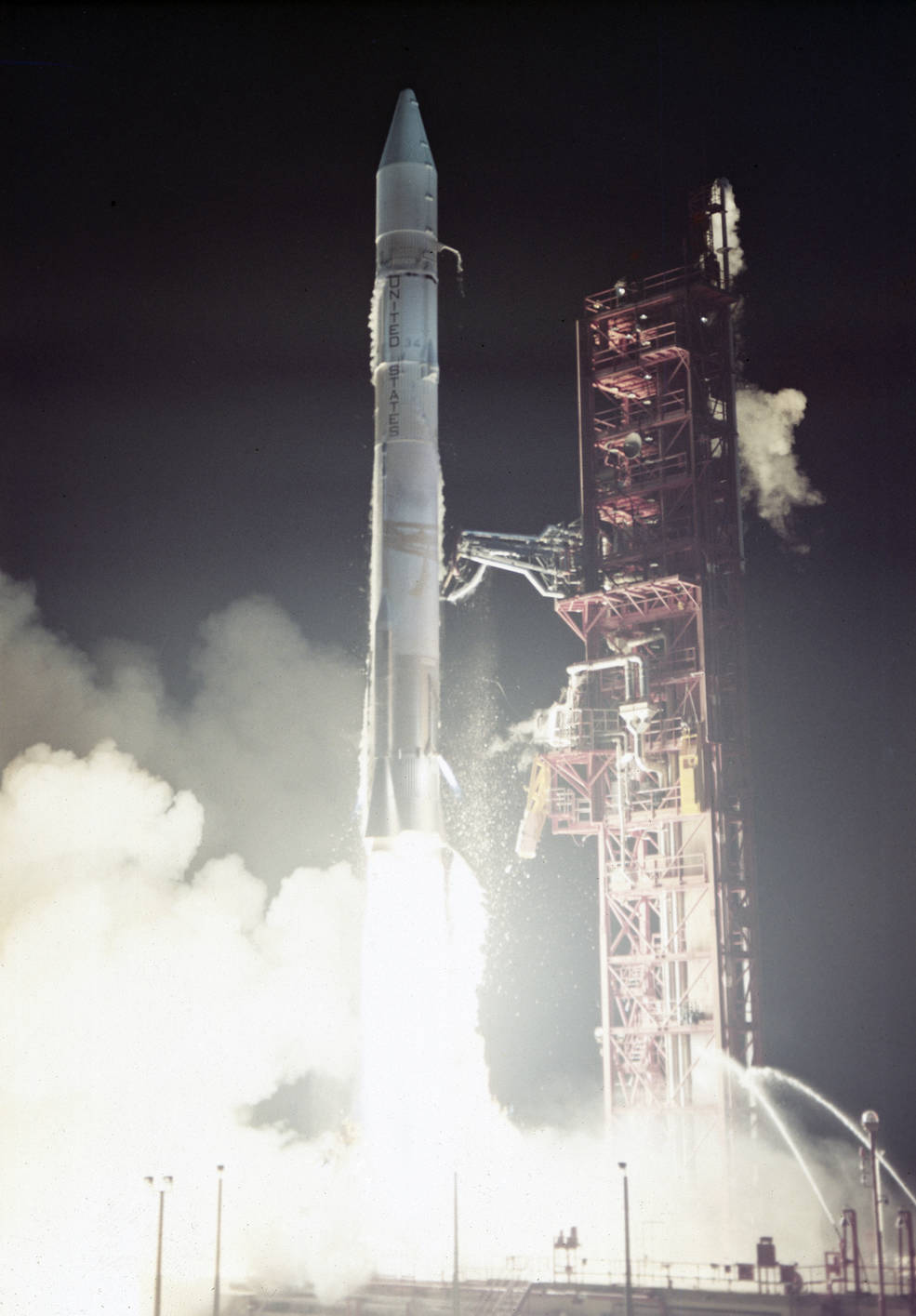
A little after midnight on November 3, 1973, an Atlas-Centaur rocket lit up the dark sky over Cape Canaveral, Florida. On top sat Mariner 10, a spacecraft weighing about 500 kilograms (roughly the weight of a grand piano), headed somewhere no spacecraft had ever been: Mercury, the small, scorched planet closest to the Sun.
It didn't fly straight there. It took a detour past Venus first, and that detour changed how we explore the solar system.
What was Mariner 10?
Mariner 10 was the last of NASA's Mariner probes, a family of spacecraft that made the first close visits to Venus and Mars in the 1960s and early 1970s. This one had two cameras with telescopes, plus instruments to measure magnetic fields, charged particles, heat and ultraviolet light. Two solar panels stuck out from its eight-sided body, and a big dish antenna sent its pictures home.
Its goal was simple to say and hard to do: get to Mercury and take a good look.
Why did Mariner 10 go to Venus first?
Getting to Mercury is tricky. Falling toward the Sun makes a spacecraft speed up, so reaching the innermost planet takes a lot of braking energy. Mission planners had a clever fix. They aimed Mariner 10 at Venus and let the planet's gravity bend its path and slow it down, sending it on toward Mercury without burning extra fuel.
This trick is called a gravity assist. Scientists had worked out the math for decades, but Mariner 10 was the first spacecraft to use one planet's gravity to reach another planet. That also made it the first spacecraft to visit two planets on one trip.
On February 5, 1974, Mariner 10 swept about 5,768 kilometers (3,584 miles) past Venus and snapped more than 4,000 pictures. Venus is wrapped in clouds that look plain in normal light, but through Mariner's ultraviolet filters, swirling patterns and sideways V-shaped bands showed up clearly.
What did Mariner 10 find at Mercury?
Mariner 10 reached Mercury on March 29, 1974, passing just 703 kilometers (437 miles) above the surface and returning more than 2,000 images. For the first time, people could see what Mercury looked like up close: a gray, heavily cratered world that resembles our Moon at first glance.
Then came a nice bit of luck. Mariner 10's orbit around the Sun took almost exactly twice as long as Mercury's, so the two met up again and again. The spacecraft made a second, more distant pass on September 21, 1974, and a third on March 16, 1975, its closest of all at 327 kilometers (203 miles).
The biggest surprise was a magnetic field. Small rocky planets weren't expected to have one, but Mariner's magnetometer picked up a weak field, about 1/60th as strong as Earth's. That hinted at a large iron core inside the planet. The spacecraft also confirmed that Mercury has an extremely thin atmosphere, made mostly of helium. Its images showed long cliffs running for hundreds of kilometers and part of a giant impact scar now known as the Caloris Basin.
How much of Mercury did Mariner 10 see?
Only about 40 to 45 percent. Because of the timing of the flybys, the same side of Mercury was in sunlight each time, so the other half stayed a mystery. For decades, textbook maps of Mercury had a big blank area.
Mariner 10 ran out of the gas it used to stay pointed in the right direction eight days after its third flyby. On March 24, 1975, controllers switched off its transmitter. It's still out there, silently orbiting the Sun.
Who finished the job?
Nobody returned to Mercury for more than three decades. NASA's MESSENGER spacecraft finally arrived and went into orbit in 2011, mapping the whole planet by 2015, and its planners leaned heavily on what Mariner 10 had learned. The joint European-Japanese BepiColombo mission is the next chapter in that story.
Why this matters
Mariner 10's biggest legacy might not be Mercury at all. It proved that gravity assists work in real life, not just on paper. Just a few years later, the Voyager probes used the same trick to hop from Jupiter to Saturn and beyond, and nearly every deep-space mission since, from Cassini to Juno to Parker Solar Probe, has borrowed a planet's pull to get where it's going.
So the next time you hear about a spacecraft swinging past Earth or Venus to pick up speed, you can thank a 500-kilogram probe that left Florida in the middle of the night 53 years ago and figured out the shortcut.
Sources
Enjoyed this? Ancient Skies is free and made by one space fan. Buy me a coffee ☕
Keep reading
Why NASA's ESCAPADE Mars Twins Are Swinging Back Past Earth This Week
NASA's twin ESCAPADE probes return to Earth Nov. 7 and 9 for a slingshot engine burn that sends them to Mars. Here's how it works and how to spot them.
November 3, 2026 · 5 min read
Why Hubble Couldn't See Beta Pictoris' Cosmic 'Cat's Tail' Until Now
Hubble finally spots the Beta Pictoris 'cat's tail' Webb found: ultra-dark carbon dust from a crash between two Ceres-sized worlds.
November 2, 2026 · 5 min read