

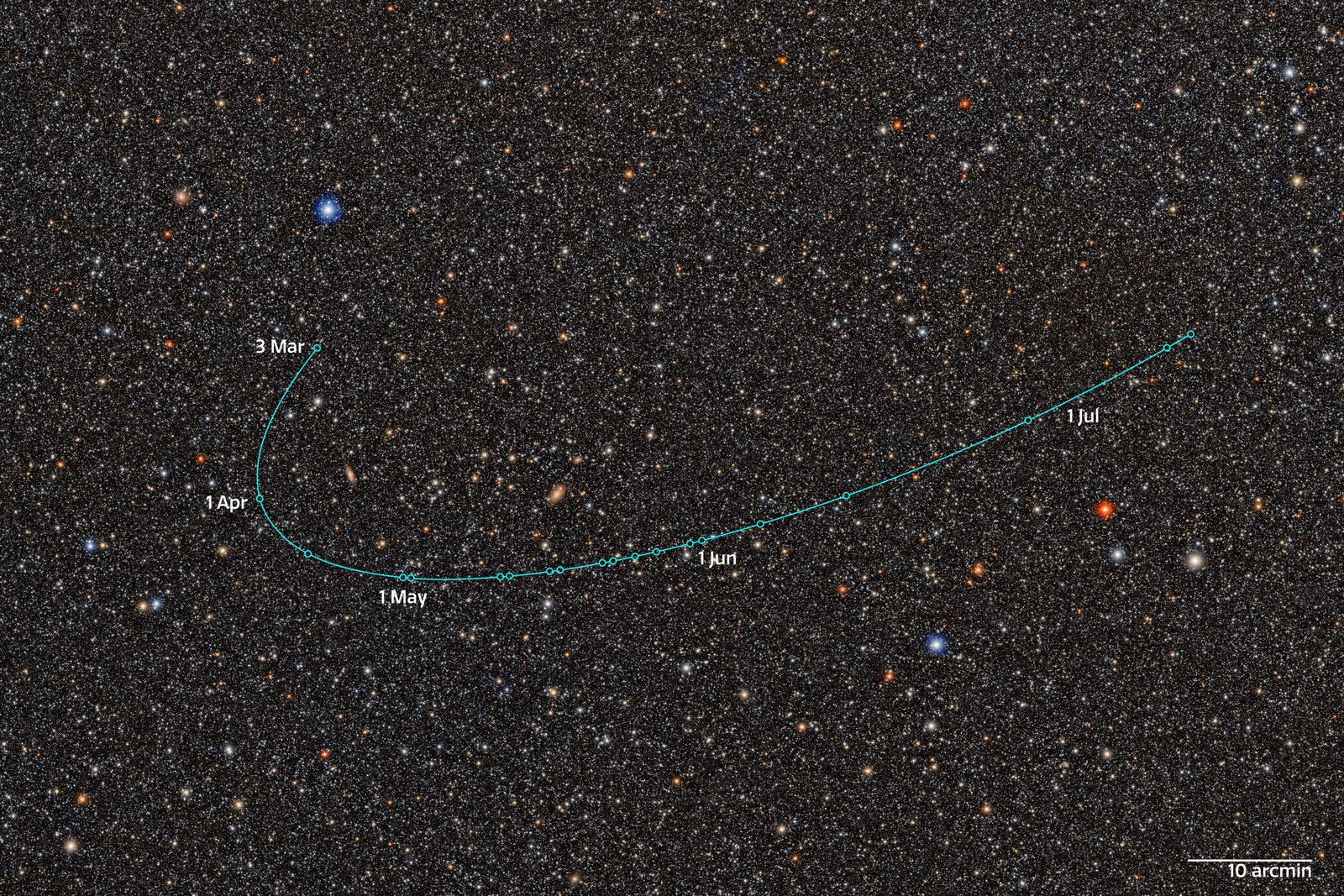
Imagine a world bigger than most of the moons in our solar system, maybe up to 930 miles (1,500 km) across, sitting out past Pluto for billions of years. Now imagine nobody noticed it, because it was hiding in front of the Milky Way.
That's what astronomers just announced. Its name, for now, is 2026 ED138. And it's the first possible dwarf planet found by the brand-new Vera C. Rubin Observatory.
What happened
On the evening of October 13, 2026, astronomer Matthew Holman of the Center for Astrophysics | Harvard & Smithsonian ran a batch of Rubin data through a search program he built with his colleague Kevin Napier. Its job is to sift through billions of moving specks of light and figure out which ones are the same object seen on different nights. Kevin Napier compared it to a giant game of connect-the-dots.
One set of dots stood out. Holman described his reaction as "excited disbelief."
Mario Jurić of the University of Washington, who leads Rubin's solar system science, then dug through Rubin's catalogs and found 20 more sightings. In all, Rubin had caught the object 30 times over 20 nights, from March 4 to July 11, 2026. The team then found it hiding in older images from the Dark Energy Camera in Chile going back to 2016, which let them trace more than 10 years of its path.
The International Astronomical Union's Minor Planet Center announced the discovery, and the team presented it on October 27 at the American Astronomical Society's planetary science meeting in Spokane, Washington.
What we know so far
One AU is the distance from Earth to the Sun, so ED138 is about 46 times farther out than we are, roughly 4.3 billion miles (6.9 billion km) away.
Why such a wide size range? Because from that far away, astronomers only see how bright it is. A small object with a shiny, icy surface and a big object with a dark surface can look exactly the same. As Holman put it, it could be a reflective object that's smaller or a dark one that's bigger. Pinning that down will take infrared observations, possibly from the James Webb Space Telescope.
Its tilted orbit makes it what astronomers call a "hot classical" object, one that probably got knocked off its original path long ago by Neptune's gravity.
And how did something this bright go unnoticed? It's in a part of the sky crowded with stars from the Milky Way, where faint moving dots get lost. Rubin, which sweeps the whole southern sky every few nights with an 8-meter telescope, is built for exactly that kind of search.
Why this matters
First, a hype check. You might see headlines calling this the "sixth dwarf planet." Not so fast. It's a candidate, not a confirmed dwarf planet, and its size could still land at the small end of the range. Officially, there are five recognized dwarf planets: Ceres, Pluto, Eris, Haumea and Makemake. But several other big objects out there, like Quaoar, Gonggong and Sedna, are already considered likely dwarf planets by many astronomers without an official ruling. So ED138 would be joining a crowd that's bigger than the official list suggests.
The bigger story is the telescope. Rubin only started its main 10-year survey in 2026, and the data that turned up ED138 came from its early months. If a world this big was still hiding in plain sight, the outer solar system almost certainly has more surprises waiting. Most known dwarf planets were spotted near the closest point of their orbits; many swing out much farther, where they get too faint for older surveys. Rubin can see deeper than that.
That also matters for one of the biggest open questions in the solar system: whether a large unseen planet is lurking far beyond Neptune. Every new distant object that Rubin finds adds a data point to that hunt.
And here's a fun bonus: Holman says ED138 is bright enough that really skilled amateur astronomers could spot it with their own gear.
What's next
- Follow-up observations, especially in infrared, to measure its true size and confirm whether it's big enough to be round.
- A real name. "2026 ED138" is a temporary label until its orbit is locked down and it's formally numbered.
- More discoveries. Rubin will keep scanning the sky for the next 10 years.
What would you name it?
Speaking of dwarf planets, did you know Pluto is smaller than our Moon? Watch our Short Pluto Is Smaller Than Our Moon.
Sources
- SLAC / Rubin Observatory: NSF–DOE Vera C. Rubin Observatory reveals its first dwarf planet candidate in our solar system (Oct. 27, 2026)
- GBH News: Potential new dwarf planet found by Harvard astrophysicists (Oct. 27, 2026)
- Universe Today: The Rubin Observatory finds its first dwarf planet candidate
- Rubin Observatory media policy (image license)
Keep reading
Japan's MMX Launches to Bring Home a Piece of Phobos, Mars's Doomed Moon
JAXA's MMX is headed for Phobos, the Martian moon that's slowly falling. If it works, it'll be the first sample ever returned from the Mars system.
October 28, 2026 · 3 min read
Artemis I's Test Dummies Flew Around the Moon. Their Radiation Results Surprised Scientists
Crystals that rode inside Artemis I's test dummies show radiation near the Moon is higher than in Earth orbit, but by far less than expected.
October 28, 2026 · 4 min read