

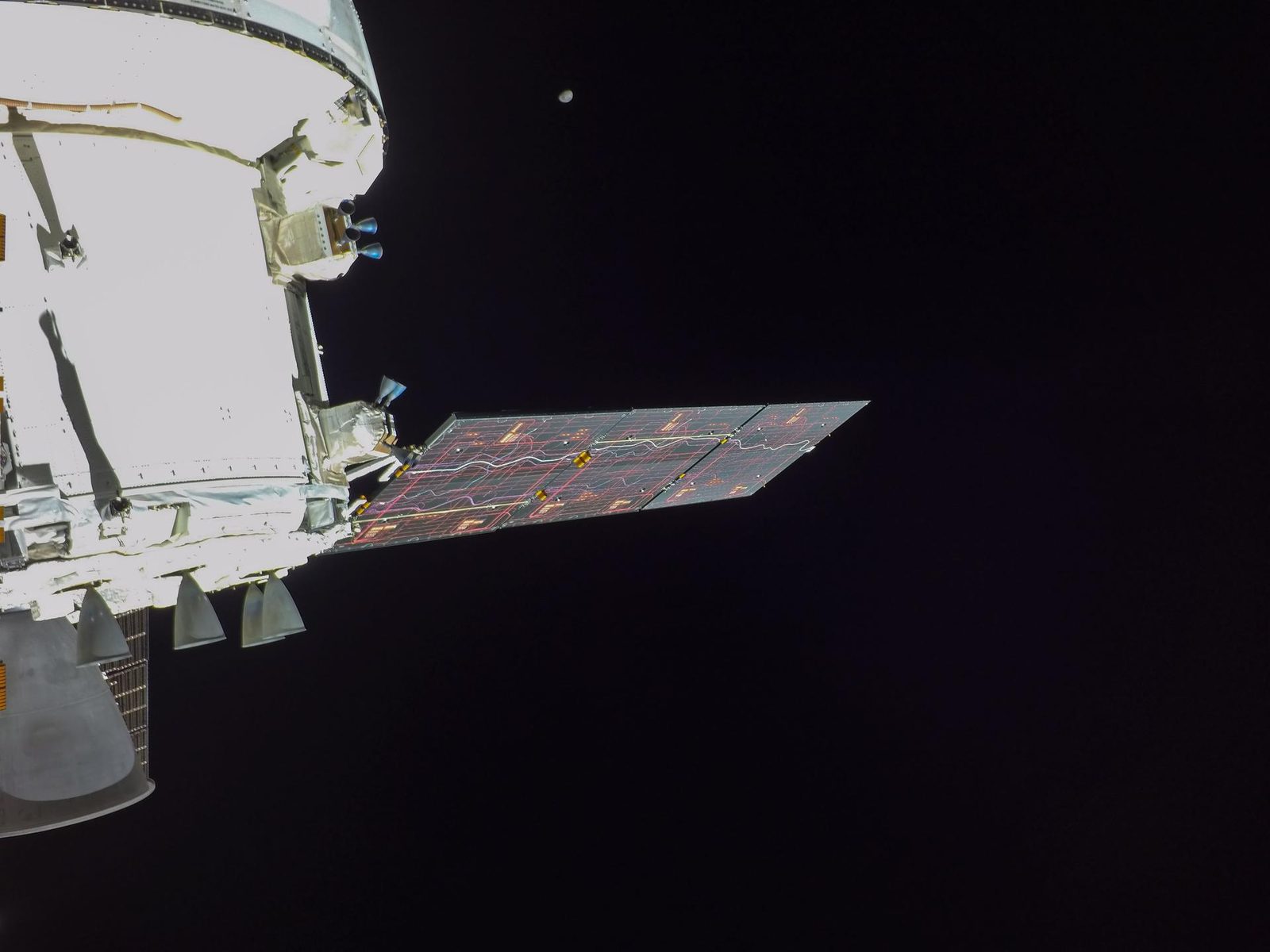
Imagine strapping into a seat on the first spacecraft built to take people back to the Moon. You've got no name, no face and no pulse. Just a torso packed with thousands of tiny radiation detectors.
That was the job of Helga and Zohar, two human-shaped test dummies that rode around the Moon on NASA's Artemis I mission. Scientists have now finished reading one batch of the crystals that flew inside them, and the answer to "how much worse is radiation near the Moon?" turned out to be: worse, but not by nearly as much as you'd think.
What happened
Artemis I launched on November 16, 2022, with no astronauts on board. The Orion capsule looped around the Moon and splashed down on December 11, after about 25 and a half days in space.
Two of its seats were taken by "phantoms," female-shaped torsos built for an experiment called MARE, led by the German Aerospace Center (DLR). Helga flew unprotected. Zohar wore a radiation-shielding vest called AstroRad, made by the Israeli company StemRad. Both were stuffed with detectors in places like the lungs, stomach and bone marrow, the parts of the body that matter most for radiation damage.
In October 2026, a team at the Institute of Nuclear Physics of the Polish Academy of Sciences (IFJ PAN) in Kraków published results from an experimental type of detector that flew inside the phantoms: tiny crystals of lithium fluoride, each just millimeters across. When a fast particle from space rips through one, it leaves a track that glows red under blue light. Scientists can read it with an ordinary fluorescence microscope, with no chemical processing needed.
Their results matched conventional detectors to within 15 percent. The crystals also picked up faint particle tracks that older detectors were too insensitive to record. The study was published in the journal Radiation Measurements.
The surprise
The total radiation dose near the Moon was higher than in low Earth orbit, where the International Space Station flies. Nobody was surprised by that part. The surprise was how small the difference was. As study co-author Paweł Bilski put it, the dose was higher, but not nearly as much as one might intuitively expect.
Here's why. Down where the space station orbits, Earth's magnetic field acts as a shield against much of the radiation coming from deep space. But that same magnetic field also traps particles in zones called the Van Allen belts, and low-energy protons from those belts make up a big share of the dose astronauts get in low orbit.
Out near the Moon, there are no Van Allen belts. Instead, the main threat is galactic cosmic rays: particles flung across the galaxy by exploding stars, moving at a good fraction of the speed of light. They're stronger out there because Earth's magnetic shield is gone. But losing the trapped belt particles partly cancels that out.
The detectors also showed a strange pattern. In low orbit, the dose inside a body is uneven, because slower particles stop at different depths. Near the Moon, the dose was spread almost evenly through the phantoms. Galactic cosmic rays carry so much energy that they shoot straight through the whole body instead of stopping near the skin.
Why this matters
"Less than expected" doesn't mean "safe." It means the steady, everyday radiation of deep space is a known, measurable problem, and that's genuinely good news for planning trips to the Moon.
The real danger is the Sun. A big solar storm can blast out a flood of particles within hours, and a crew caught outside Earth's magnetic field has nowhere to hide. That's where the other half of this experiment comes in. In a study published in August 2026, the MARE team used their Artemis I data to estimate how much the AstroRad vest would help in a monster storm. For a storm like the huge one in August 1972, which hit between Apollo missions, the vest cut the estimated dose by about 60 percent. For a storm like one in October 1989, the reduction was just under 40 percent.
And there's a lesson about the galactic cosmic rays too. If they pass straight through a whole human body, they pass through a lot of spacecraft wall as well. You can't fully block them; you can only limit how long you're exposed. That's fine for a trip to the Moon lasting a few weeks. For a trip to Mars, lasting months each way, it's one of the hardest problems engineers still have to solve.
What's next
- The crystal detectors themselves are a win. They're cheap, easy to read and sensitive, so they could fly on future crewed missions to track what each astronaut actually absorbs.
- Artemis II already carried a crew around the Moon in April 2026. Every crewed mission adds real measurements on top of what Helga and Zohar collected.
- Researchers are still digging through MARE's thousands of detectors, so expect more results.
Would you sign up for a trip around the Moon knowing all this? And would you wear the vest?
Want the full story of the crewed mission that followed? Watch our video Artemis II Explained: Why It Mattered and What Comes Next.
Sources
- Bioengineer.org: Crystal detectors reveal cosmic radiation doses near the Moon on Artemis I (IFJ PAN study, Radiation Measurements)
- Time News: IFJ PAN crystals record Moon radiation on NASA Artemis I mission
- DLR: AstroRad vest can significantly reduce radiation exposure for humans in space (Aug. 2026)
- DLR: The MARE cosmic radiation experiment on board Artemis I
Keep reading
A Possible New Dwarf Planet Just Turned Up Beyond Pluto. Meet 2026 ED138
The Rubin Observatory's first dwarf planet candidate was hiding in front of the Milky Way. Here's what we know about 2026 ED138, and what's still hype.
October 28, 2026 · 3 min read
Japan's MMX Launches to Bring Home a Piece of Phobos, Mars's Doomed Moon
JAXA's MMX is headed for Phobos, the Martian moon that's slowly falling. If it works, it'll be the first sample ever returned from the Mars system.
October 28, 2026 · 3 min read