
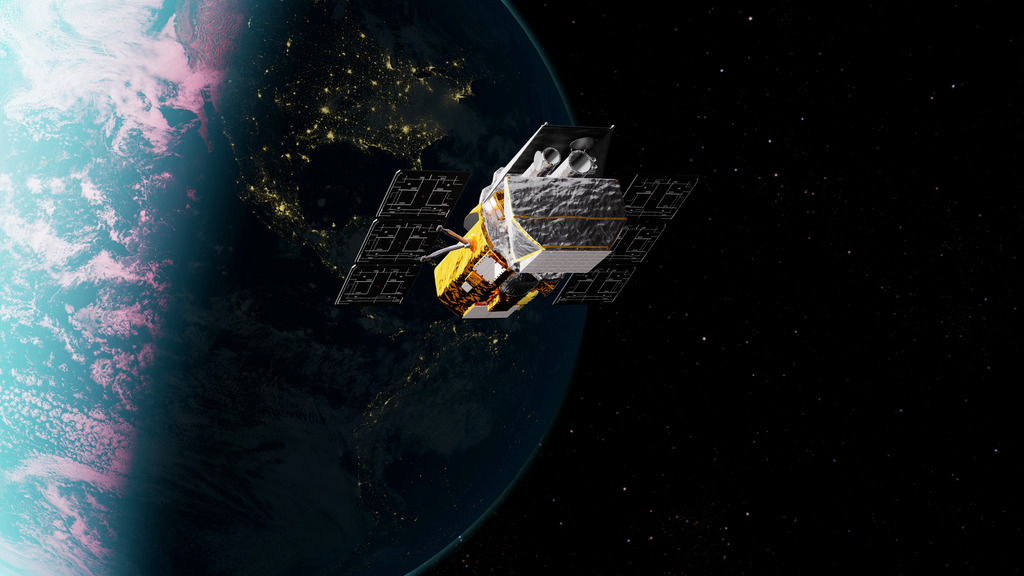
Imagine you're a telescope. For almost 22 years you've been the universe's first responder. Somewhere billions of light-years away, a star collapses or two dead stars smash together, and within about a minute you've swung around to look.
Now you're falling. A rescue ship was sent up to catch you. And it couldn't.
That's the real story of NASA's Swift observatory, which officially ended its science mission this week. It's a story about the Sun, a $30 million gamble, and a spacecraft that kept working right up until the sky pulled it down.
What happened
NASA's Neil Gehrels Swift Observatory launched on November 20, 2004, into a circular orbit about 370 miles (600 km) up. It was built for a two-year mission. It lasted nearly 22.
The problem is that "orbit" isn't forever. Even up there, there's a whisper of atmosphere, and it drags on everything. When the Sun gets active, it heats and puffs up Earth's upper atmosphere, and that drag gets stronger. A burst of strong solar activity in 2024 made Swift start sinking much faster than anyone planned for. Swift has no rocket engine of its own, so it couldn't push itself back up.
So NASA tried something nobody had done before. In September 2025, it gave a startup called Katalyst a $30 million contract to build a robotic spacecraft, called LINK, that would fly up, grab Swift and push it into a higher orbit. Katalyst had less than a year to pull it off.
LINK launched on July 3, 2026, on a Pegasus XL rocket dropped from a plane near Kwajalein Atoll in the Pacific. Then things went wrong. LINK had trouble controlling which way it was pointing, started spinning, and lost two of its three pointing wheels while its small gas thrusters also acted up. On August 19, NASA called off the capture.
"This is not the outcome we were working toward." — NASA Administrator Jared Isaacman
Swift's last stand
Here's the part most headlines skipped. While the rescue was coming together, Swift's team had cut back its science to reduce drag and buy time. Once the rescue was off, they did the opposite.
On August 28, Swift went back to full-time science, watching hundreds of targets: the remains of exploded stars, hungry supermassive black holes in distant galaxies, and comets in our own solar system. On September 25, it switched its third telescope back on and started swinging around automatically again. That movement added drag, and Swift began dropping fast.
On October 20, it hit 171 miles (275 km), too low to hold steady on a target, and went into safe mode. The team at Penn State, which has run Swift's day-to-day operations, then sent the command that ended the mission. NASA expects Swift to fall back into the atmosphere within weeks.
Why Swift mattered so much
Swift was built to catch gamma-ray bursts, the most powerful explosions in the universe. They can be over in less than a second, so speed was everything. Swift could spot one with its wide-view detector, then turn its X-ray and ultraviolet telescopes onto the spot in about a minute, all on its own.
One of its greatest hits came in May 2005, just months into the mission. A burst lasting 0.03 seconds flashed in the sky. Swift turned fast enough to catch the fading X-ray glow it left behind, just 11 tiny particles of X-ray light. That was the first time anyone caught the afterglow of a short burst, and it pointed to a wild answer for what causes them: two neutron stars, the collapsed cores of dead stars, crashing into each other.
The mission is named after Neil Gehrels, its first lead scientist, who died in 2017. Swift was renamed in his honor the following year.
Why this matters
Swift didn't die because it broke. Every instrument still worked. It died because of the Sun, and because nobody had ever built a tow truck for space telescopes.
That's the part that should make us a little nervous. We've filled low orbit with incredible machines, and most of them can't push themselves back up when space weather turns rough. Hubble is in the same boat: no engine of its own, and slowly sinking over time. Swift's rescue failed, but it was the first real attempt at saving a science telescope this way, built in under a year. The next one will have this one's lessons.
And there's a real gap now. For the first time since 2004, there's no dedicated spacecraft whose whole job is to chase the universe's biggest explosions within seconds. NASA says it will lean on its other telescopes and look at new, faster missions to cover for Swift. Until then, some of the most extreme events in the cosmos may flash and fade with nobody looking quickly enough.
If you're going to fall, though, Swift did it right. It spent its last weeks doing exactly what it was built for.
What's next
- Swift is expected to re-enter Earth's atmosphere in the coming weeks.
- Its full archive, about 12 terabytes including more than 1.5 million ultraviolet and optical images, stays free for anyone to use. Scientists will keep making discoveries with it for decades.
- NASA is looking at commercial and fast-to-launch options for a future rapid-response telescope.
Sources
- NASA: NASA's Swift Mission Ends, Leaves Behind Scientific Bonanza (Oct. 23, 2026)
- NASA Swift blog: NASA's Swift Mission Ends Ahead of Re-Entry (Oct. 23, 2026)
- NASA: NASA Updates Next Steps for Commercial Swift Boost Mission (Aug. 19, 2026)
- Smithsonian Magazine: NASA-funded mission to rescue a falling space telescope officially ends in failure
- Eos: Swift Observatory Rescue Mission Fails
Keep reading
A Possible New Dwarf Planet Just Turned Up Beyond Pluto. Meet 2026 ED138
The Rubin Observatory's first dwarf planet candidate was hiding in front of the Milky Way. Here's what we know about 2026 ED138, and what's still hype.
October 28, 2026 · 3 min read
Japan's MMX Launches to Bring Home a Piece of Phobos, Mars's Doomed Moon
JAXA's MMX is headed for Phobos, the Martian moon that's slowly falling. If it works, it'll be the first sample ever returned from the Mars system.
October 28, 2026 · 3 min read