

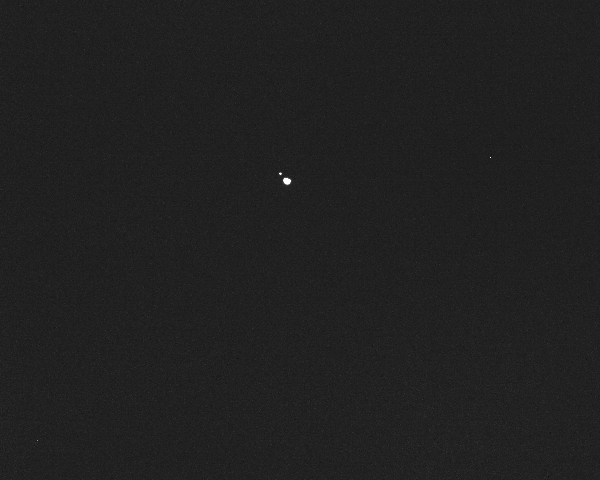
ESA's Hera spacecraft has just taken its first picture of the Didymos asteroid system as two separate objects. And if you're picturing a dramatic close-up, adjust your expectations: it's two dots. One bigger, one smaller, sitting next to each other in the dark.
Here's why those two dots are a big deal. The smaller one is Dimorphos, the asteroid NASA deliberately smashed a spacecraft into four years ago. Hera is the detective sent to the scene of the crash, and it has finally spotted the victim.
What did Hera actually see?
Hera snapped the image in mid-October with its Asteroid Framing Camera, a black-and-white navigation and science camera. At the time it was about 795 miles (1,280 km) from the asteroid pair. ESA released the picture on October 27, 2026.
Until this shot, Hera's camera had only ever seen Didymos and its moonlet blurred together into a single point of light. Now there's a clear gap between them. Dimorphos fills roughly one pixel, but it's unmistakably its own object.
ESA project scientist Michael Kueppers summed it up simply: Dimorphos is now "clearly well separated from its parent body."
What are Didymos and Dimorphos?
Didymos is a near-Earth asteroid about 2,560 feet (780 m) across. ESA compares it to a building just a little shorter than Dubai's Burj Khalifa. Circling it is a much smaller moonlet, Dimorphos, about 495 feet (151 m) wide, roughly the size of the Great Pyramid of Giza.
The two sit only about 0.7 miles (1.15 km) apart on average. Dimorphos drifts around its parent slowly, at about 18 centimeters per second. That's slower than you'd stroll across your living room.
Neither asteroid is on a collision course with Earth. That's exactly why scientists chose them: a safe target for a real test.
Didymos or Dimorphos: which one did DART hit?
The names trip a lot of people up, so here's the quick version. Didymos (Greek for "twin") is the big one. Dimorphos ("two forms") is the small moonlet, and it's the one that got hit.
On September 26, 2022, NASA's DART spacecraft slammed into Dimorphos at about 3.8 miles per second (6.1 km/s). The goal was to see whether a fast-moving spacecraft could nudge an asteroid. It worked better than anyone hoped. The impact shortened Dimorphos's orbit around Didymos by about 33 minutes, when the mission only needed to change it by 73 seconds to count as a success. It also blasted out a debris plume thousands of miles long.
ESA calls Dimorphos the first object in the solar system whose orbit has been measurably shifted by human action. Not bad for a rock the size of a pyramid.
Why send Hera if DART already worked?
Because DART only told us half the story. We know the orbit changed. What we don't know well is why it changed so much.
Was Dimorphos a loose pile of rubble that sprayed debris like a beanbag hit by a baseball? That spray would act like a rocket, pushing the asteroid harder than the impact alone. How big is the crater? How heavy is Dimorphos, really? Those numbers decide how well the same trick would work on a different asteroid someday.
Earth-based telescopes can measure the orbit. They can't see the crater. Hera can.
When does Hera arrive at Didymos?
Very soon. Hera launched on October 7, 2024, swung past Mars and its moon Deimos in March 2025, and has been closing in ever since. Earlier this month, two braking burns a week apart slowed it to just 20 meters per second relative to the asteroids, about 45 mph. ESA has said Hera is on track to arrive in November 2026, a month earlier than first planned, thanks to braking later and harder on approach.
Once there, it will spend about six months studying the pair, working its way closer over time. It will also release two shoebox-sized CubeSats, Milani and Juventas. Milani will study the minerals in the dust and rock. Juventas carries a radar designed to peer beneath Dimorphos's surface.
Can you see Didymos from Earth?
Not with your eyes, binoculars or a backyard telescope. Didymos is under half a mile wide and currently about 122 million miles away, which makes it extremely faint. Only large observatory telescopes can pick it out, and even they see the pair as one point of light. Seeing Dimorphos on its own took a spacecraft flying right up to it.
The good news: you won't need a telescope to see the close-ups. ESA plans to share them.
Why this matters
Think about how strange this moment is. For billions of years, nothing in the solar system has moved an asteroid on purpose. Then we did. And now we've sent a second spacecraft out to check our work, like a crash investigator walking back to the scene with a notebook.
That's the part most headlines skip. DART was the experiment. Hera is the measurement. A planetary defense plan you can't measure is just a guess. With Hera's data, scientists can work out how much push you get from a given impact on a given kind of asteroid. If a real threat ever shows up, that number is the difference between "we think this will work" and "we know how hard to hit it."
And it starts with two dots. Every great close-up of an alien world began exactly like this: a blur, then a pair of pixels, then a whole new place.
What's next
ESA says it will unveil the first detailed images of Dimorphos on November 25, 2026. That's when we should get our first real look at how DART reshaped it. Over the following months, Hera will map both asteroids, measure their masses, hunt for the impact crater, and deploy its CubeSats for an even closer look. At the end, the CubeSats are expected to attempt landings on Dimorphos.
So here's the question for you: when those November close-ups arrive, what do you think we'll find where DART hit? A neat crater, or a moonlet that got reshaped altogether?
Sources
Enjoyed this? Ancient Skies is free and made by one space fan. Buy me a coffee ☕
Keep reading
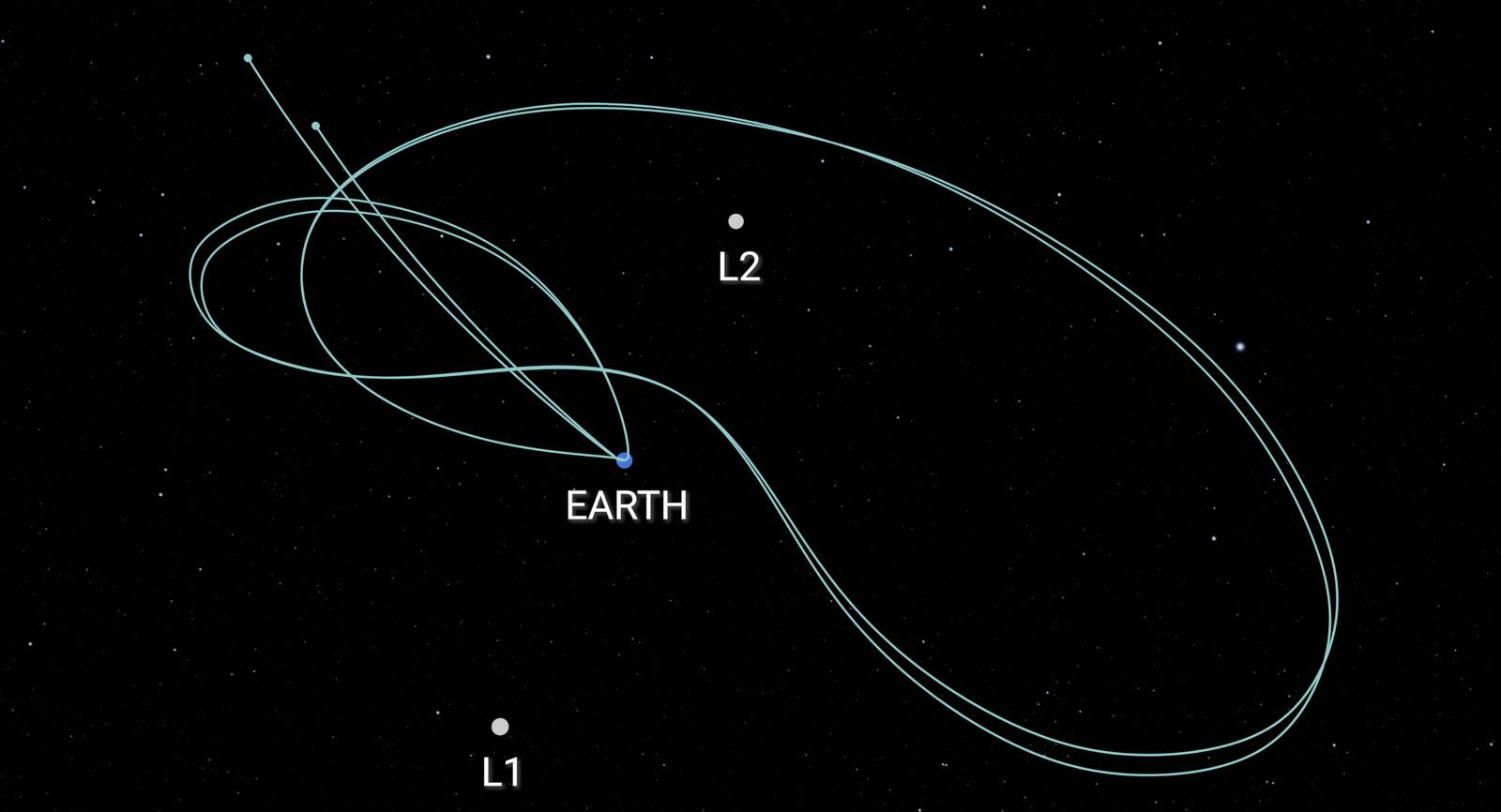
Why NASA's ESCAPADE Mars Twins Are Swinging Back Past Earth This Week
NASA's twin ESCAPADE probes return to Earth Nov. 7 and 9 for a slingshot engine burn that sends them to Mars. Here's how it works and how to spot them.
November 3, 2026 · 5 min read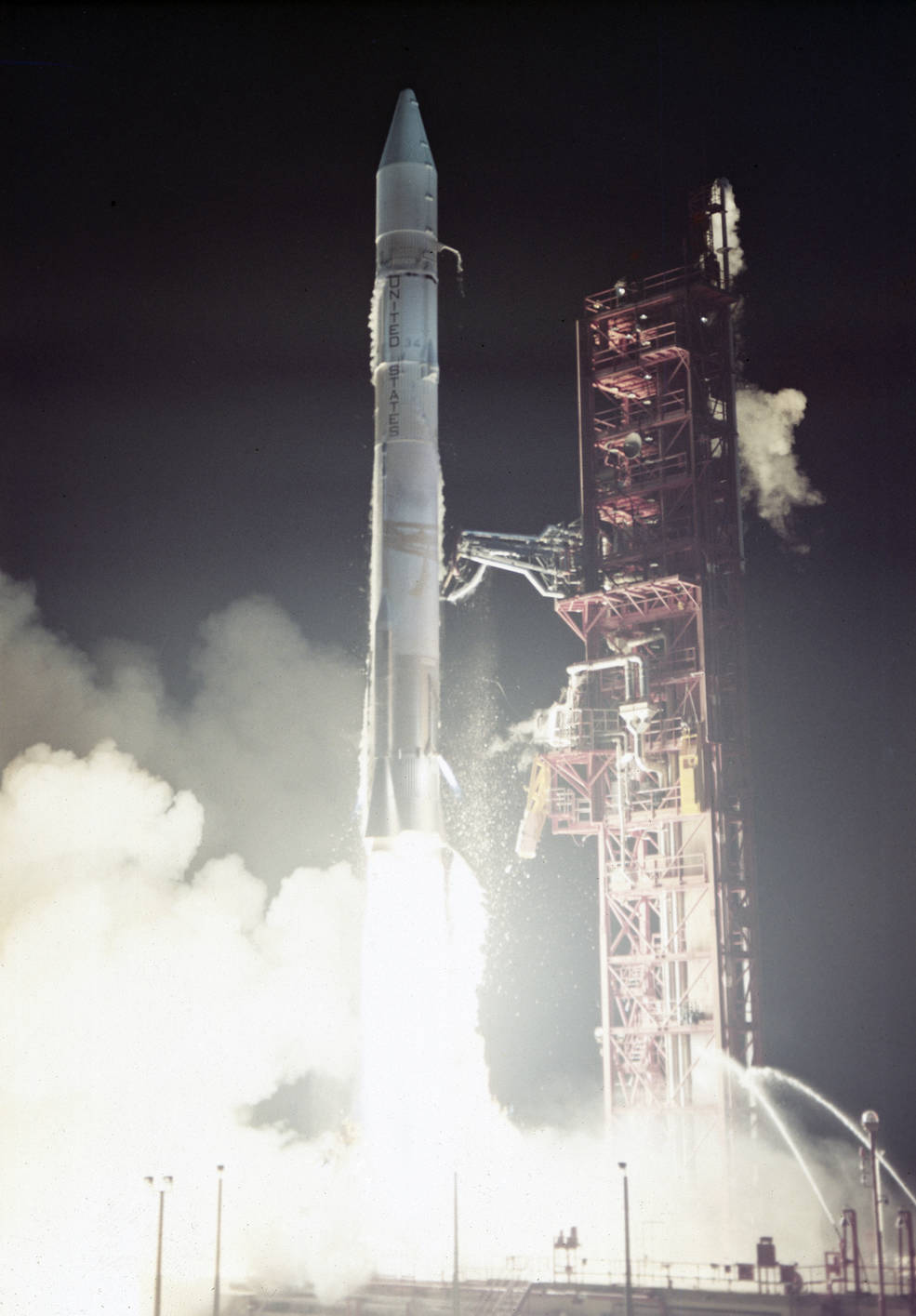
Today in Space History, Nov. 3: Mariner 10 Heads for Mercury by Way of a Venus Slingshot
On Nov. 3, 1973, NASA launched Mariner 10, the first probe to visit Mercury and the first to use one planet's gravity to reach another.
November 3, 2026 · 3 min read