
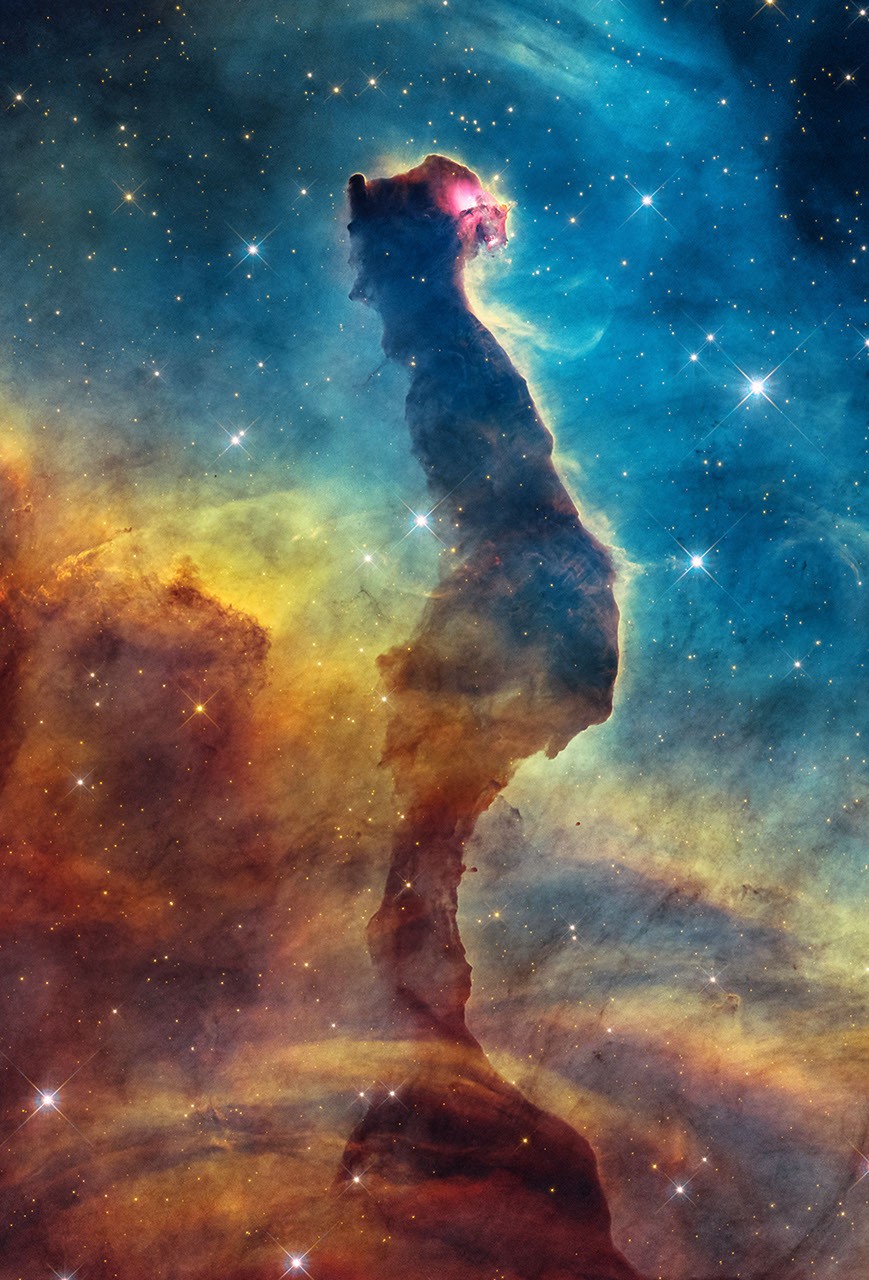
Just in time for Halloween, the Hubble and James Webb space telescopes have spotted a cat lurking in the dark. It's called the Cat's Head Nebula, and once you see it, you can't unsee it: the pointed ears, the head turned to one side, the tail curling down.
It even has a glowing eye. That single bright dot sits right where a cat's eye should be, and it might be the most interesting thing in the whole picture.
What is the Cat's Head Nebula?
The Cat's Head Nebula is a pillar of dense dust and gas inside the Carina Nebula, one of the biggest and busiest star-forming clouds in our galaxy. NASA and ESA released three new views of it on October 29, 2026: one from Hubble in visible light, and two from Webb in near-infrared and mid-infrared light.
It isn't a separate object so much as a nickname for one dusty structure. Seen from our angle, it happens to look like a cat sitting with its back to us, glancing over its shoulder.
How far away is the Cat's Head Nebula?
About 7,500 light-years. The light in these images left the nebula before humans had even invented writing. The Carina Nebula sits in the southern constellation Carina, and if the name sounds familiar, it's the same nebula that gave us Webb's famous "Cosmic Cliffs" image in 2022.
Why do Hubble and Webb's images look so different?
Because they're seeing different kinds of light, and dust treats each kind differently. Put them side by side and it barely looks like the same object.
Hubble (visible light) shows the cat as a dark brown silhouette. Dust this thick blocks visible light, so we see its outline against the glowing gas behind it. A hazy yellow rim runs along one edge, where ultraviolet light from nearby giant stars is heating the gas and slowly boiling it away. The eye glows red.
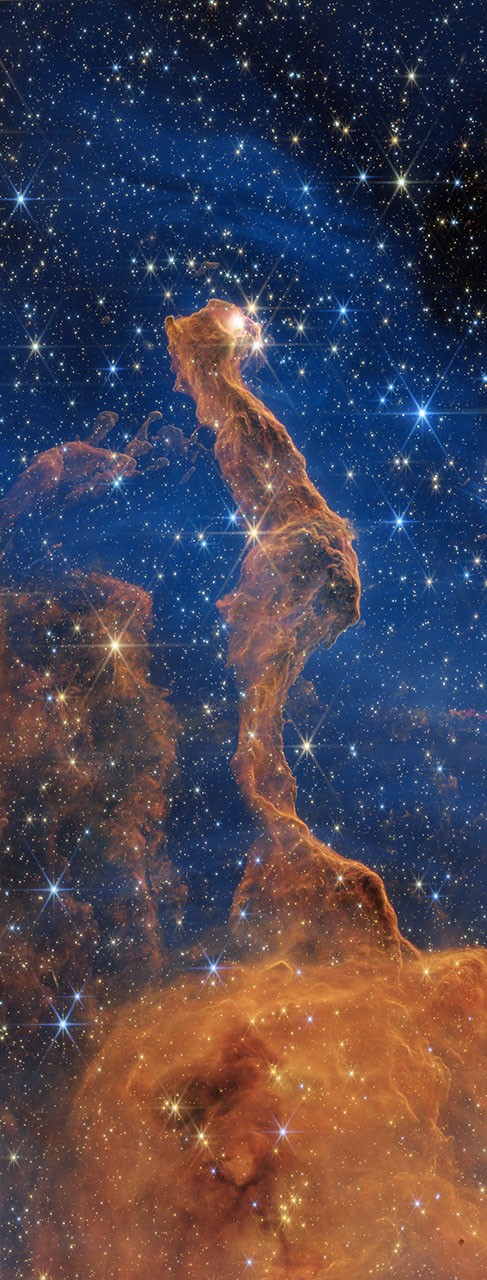
Webb's NIRCam (near-infrared) sees through much of that dust. The pillar turns partly see-through, its surface texture pops out, and dozens of hidden stars appear, some still wrapped in dust. Webb also caught faint background galaxies and a thin jet near the cat's belly.
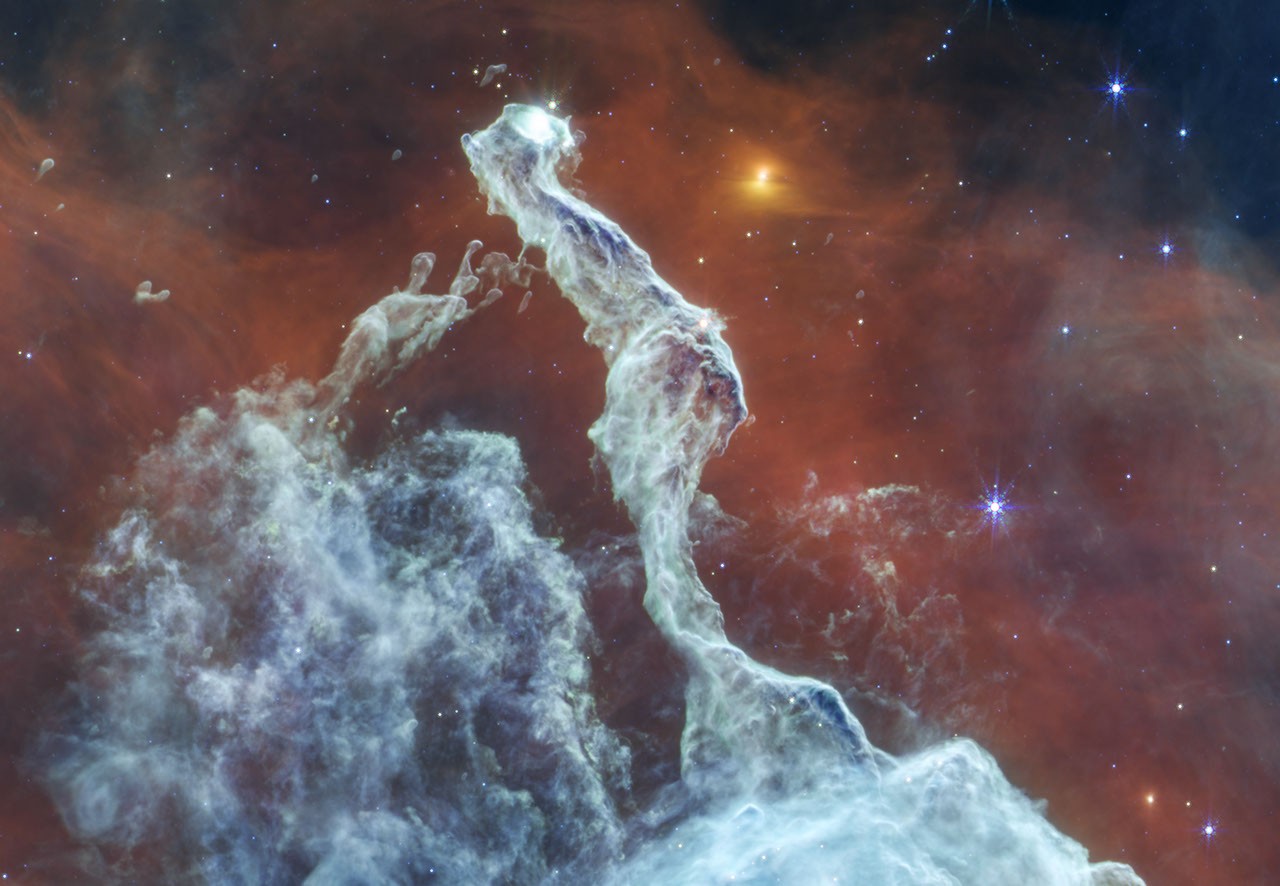
Webb's MIRI (mid-infrared) swaps starlight for warm dust. The cat glows in pale blues and greens, outlined by carbon-based molecules lit up by starlight, and delicate knots and strands appear beside the pillar that were invisible in the other two views.
Why does a dust cloud look like a cat?
Partly, that's your brain. Humans are wired to find faces and animals in random shapes, the same reason you see shapes in clouds.
But the shape itself is real, and it's carved by violence. The Carina Nebula is home to some of the most massive stars known. Their intense ultraviolet light and powerful winds erode the surrounding gas, the way a sandblaster eats away soft rock. Denser clumps of dust hold out longer, leaving pillars, ridges and, every so often, cats.
Cat's Head Nebula vs. Cat's Eye Nebula: not the same thing
Some coverage of this story mixed the two up, so here's the difference. The Cat's Head Nebula is a dusty pillar in the Carina Nebula, about 7,500 light-years away, where new stars are forming. The Cat's Eye Nebula (NGC 6543) is a completely different object in the northern constellation Draco, about 3,000 light-years away. It's the glowing shell of gas thrown off by a dying star, one of Hubble's most famous images.
So one cat is a stellar nursery, and the other is what's left when a star like our Sun runs out of fuel.
Can you see the Cat's Head Nebula?
Not the cat itself. It's a small feature that takes serious astrophotography gear, or a space telescope, to pick out.
The Carina Nebula around it is another story. From the Southern Hemisphere it's visible with your eyes alone on a dark night, a hazy glow a few times wider than the full Moon, best placed in the evening sky from about January to May. From most of the United States it's too far south to see, though it barely clears the horizon from the southern tips of Texas and Florida.
Why this matters
That glowing eye is the real story. NASA and ESA say it may be a young star still embedded in the dust, which means a star may be forming right inside the cat.
Pillars like this are where stars are made. Gravity pulls the densest knots of gas together until they ignite, while the radiation from older stars around them tries to blow everything apart. It's a race, and the eye could be a star that won.
And the cat won't last. The same starlight that sculpted it is still eating it away. Over a long stretch of cosmic time, the pillar will erode, the shape will change, and whatever stars formed inside will be left standing in the open. We just happen to be around for the brief window when it looks like a cat.
It's also a great reminder of why astronomers want more than one telescope. Hubble shows the silhouette. Webb shows what's hiding inside it. Together, a spooky shadow turns into a working star factory.
More spooky things in space
The Cat's Head isn't the only Halloween-ready object up there:
The Witch Head Nebula (IC 2118) is a cloud of dust about 900 light-years away near the bright star Rigel in Orion, shaped like a witch's profile with a long nose and pointed chin.
The "Skull" asteroid (2015 TB145) flew past Earth on Halloween 2015 at about 1.3 times the distance to the Moon, and radar images made it look eerily like a skull.
What's next
The images alone can't confirm what the eye is, and the agencies are careful to say a bright source near the pillar in the mid-infrared view may not even be connected to it. Follow-up observations could pin down whether the eye really is a young star forming inside the cat. Meanwhile, Hubble and Webb keep teaming up on regions like this, so there are almost certainly more cosmic animals waiting to be found.
So, what do you see when you look at it: a cat, or something else entirely?
Sources
Enjoyed this? Ancient Skies is free and made by one space fan. Buy me a coffee ☕
Keep reading
Why NASA's ESCAPADE Mars Twins Are Swinging Back Past Earth This Week
NASA's twin ESCAPADE probes return to Earth Nov. 7 and 9 for a slingshot engine burn that sends them to Mars. Here's how it works and how to spot them.
November 3, 2026 · 5 min read
Today in Space History, Nov. 3: Mariner 10 Heads for Mercury by Way of a Venus Slingshot
On Nov. 3, 1973, NASA launched Mariner 10, the first probe to visit Mercury and the first to use one planet's gravity to reach another.
November 3, 2026 · 3 min read