
Algol, the "Demon Star," is one of the brightest stars in the Halloween sky, and tonight it's going to do something creepy: it's going to fade. No telescope needed. Just step outside, look northeast, and watch a star lose most of its light over a few hours, then come right back.
People have been unsettled by this star for a very long time. Its name literally means "the demon's head." Here's what's really going on, and exactly when to look this Halloween night.
What is Algol, the Demon Star?
Algol (also called Beta Persei) is a star in the constellation Perseus, about 90 light-years from Earth. To your eye it looks like one ordinary star. It's actually three stars, and two of them are locked in a tight orbit, circling each other every 2 days, 20 hours and 49 minutes.
Why does Algol dim? (It's not really blinking)
Algol doesn't flicker, pulse or switch off. What you're seeing is an eclipse.
The main star is hot, bright and blue-white. Its partner is a cooler, dimmer orange star that's actually bigger. From Earth, we happen to see their orbit almost edge-on. So every 2.87 days, the big dim star slides in front of the bright one and blocks a big chunk of its light. Algol drops from about magnitude 2.1 to 3.4, which means it gets roughly three times fainter. Then the dim star moves on, and Algol brightens back to normal.
That's why astronomers call stars like this "eclipsing binaries," and Algol is the most famous one in the sky. It's so famous that this whole family of stars is named after it: "Algol-type" variables.


Why is Algol called the Demon Star?
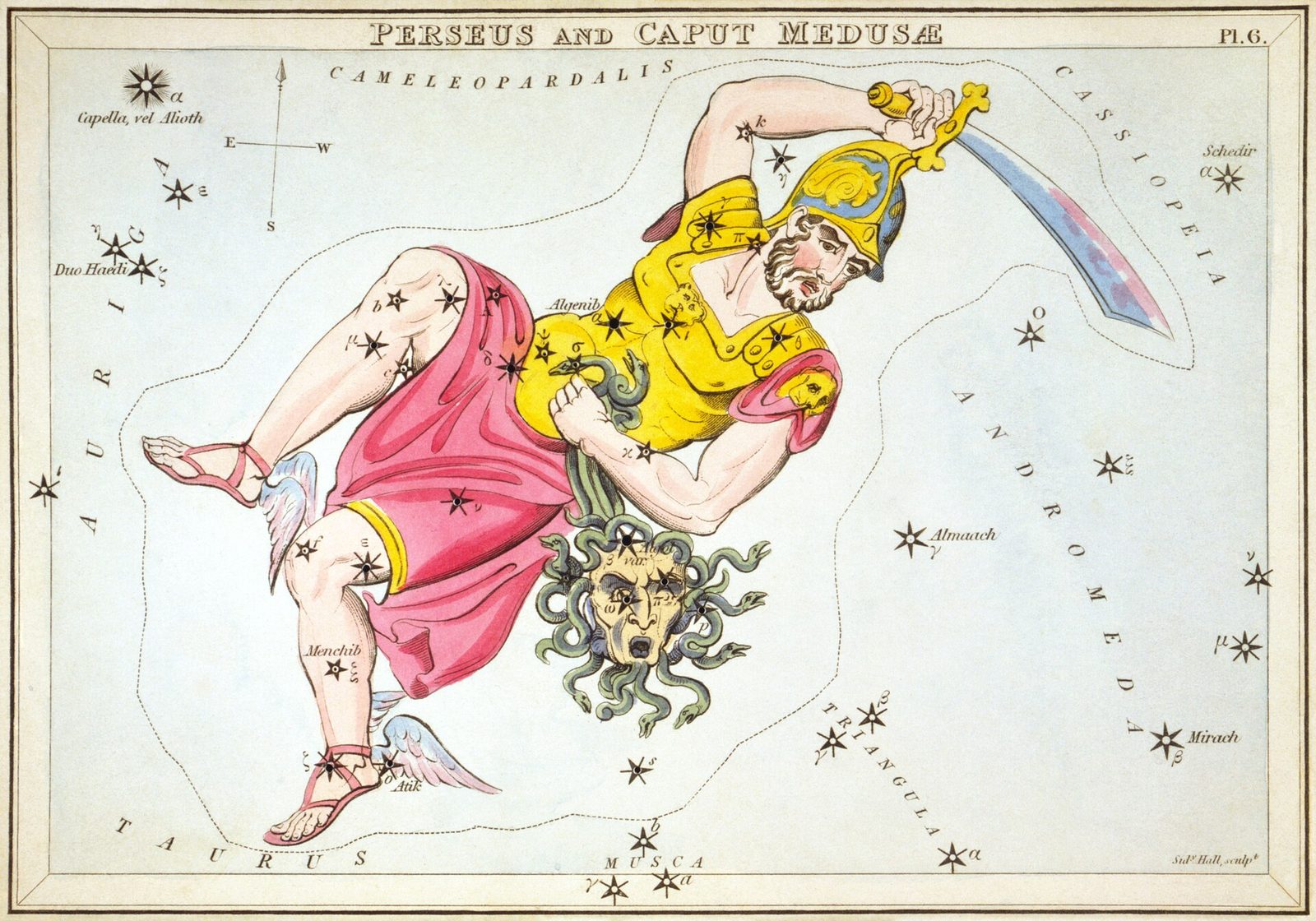
The name comes from the Arabic ra's al-ghūl, "the head of the demon" (or ogre). In Greek myth, the constellation Perseus shows the hero holding up the severed head of Medusa, the monster whose gaze turned people to stone. Algol marks Medusa's head, which is why another old name for it is Gorgonea Prima, "the first star of the Gorgon."
And it keeps going. Old Hebrew folklore called it "Satan's Head," and a 16th-century Latin name was Caput Larvae, "the Spectre's Head." In Chinese astronomy, it's part of a group of stars called the Mausoleum. A star that winks in and out probably didn't help its reputation.
Did ancient people notice Algol dimming?
Officially, the first recorded notice came from Italian astronomer Geminiano Montanari in 1667. Then in 1782 and 1783, John Goodricke, an 18-year-old English amateur astronomer who had been deaf since childhood, timed the dimmings, worked out the regular cycle, and suggested a dark body was passing in front of the star. He was right, and the Royal Society awarded him its Copley Medal for it.
There's a much older possibility, too. A team of researchers in Finland has argued that an ancient Egyptian calendar of lucky and unlucky days, written about 3,200 years ago, encodes a cycle that matches Algol. Other researchers disagree, so it's still debated. But it's a fun thought: someone in ancient Egypt may have watched this same star fade, long before anyone knew why.
Can you see Algol tonight?
Yes, and with just your eyes. Algol is easy to see from cities, even with moonlight.
- Where to look: after dark, face northeast. Find the "W" shape of Cassiopeia, then look below it for Perseus. Perseus's brightest star is Mirfak. Algol is the bright star about a fist-width (at arm's length) south of Mirfak.
- When it fades (Halloween night, U.S. times): Algol starts dimming around 10:20 p.m. Eastern, 9:20 p.m. Central, 8:20 p.m. Mountain and 7:20 p.m. Pacific on Saturday, October 31.
- When it's dimmest: around 07:20 UT on Sunday, November 1. Clocks fall back that night, so that's about 2:20 a.m. Eastern Standard, 1:20 a.m. Central Standard, 1:20 a.m. Mountain Daylight and 12:20 a.m. Pacific Daylight. Predictions can be off by a little, so give yourself some wiggle room.
- How to tell it's dimmer: normally Algol is about as bright as Almach, the bright star at the end of Andromeda. At its faintest, it drops below Epsilon Persei, a star a little east of it in Perseus. Look early in the evening, then again later, and compare.
If you miss tonight's, Algol does it again every 2 days, 21 hours. The next easy U.S. evening dimming is Friday, November 6, when it should hit its faintest around 7 p.m. Central (8 p.m. Eastern).
Why this matters
Most of what's spooky in space needs a giant telescope to see. Algol is different. It's a real star system, doing real physics, that you can watch change with your own eyes from your front yard. That's rare.
It's also a reminder that the sky isn't as fixed as it looks. Algol taught astronomers that some "single" stars are actually pairs, and that we can measure them just by watching their light. That same trick, watching for a dip in a star's light, is how telescopes like NASA's Kepler and TESS have found thousands of planets around other stars. The method that found other worlds started with a star people once called a demon.
And there's a twist that astronomers call the "Algol paradox." The dim star in the pair is the less massive one, yet it's further along in its life, which shouldn't happen, since heavier stars age faster. The answer: it used to be the heavier star, until its partner pulled away most of its mass. In a way, the bright star has been slowly feeding on its companion for millions of years. Pretty fitting for Halloween.
What's next
- Tonight: watch Algol fade in the evening and bottom out after midnight.
- Every 2.87 days: it repeats, all through the fall and winter, when Perseus is high in the evening sky.
- Next good U.S. evening: Friday, November 6.
Happy Halloween from Ancient Skies. Are you going out to catch the Demon Star tonight?
Sources
Enjoyed this? Ancient Skies is free and made by one space fan. Buy me a coffee ☕
Keep reading
Why NASA's ESCAPADE Mars Twins Are Swinging Back Past Earth This Week
NASA's twin ESCAPADE probes return to Earth Nov. 7 and 9 for a slingshot engine burn that sends them to Mars. Here's how it works and how to spot them.
November 3, 2026 · 5 min read
Today in Space History, Nov. 3: Mariner 10 Heads for Mercury by Way of a Venus Slingshot
On Nov. 3, 1973, NASA launched Mariner 10, the first probe to visit Mercury and the first to use one planet's gravity to reach another.
November 3, 2026 · 3 min read